
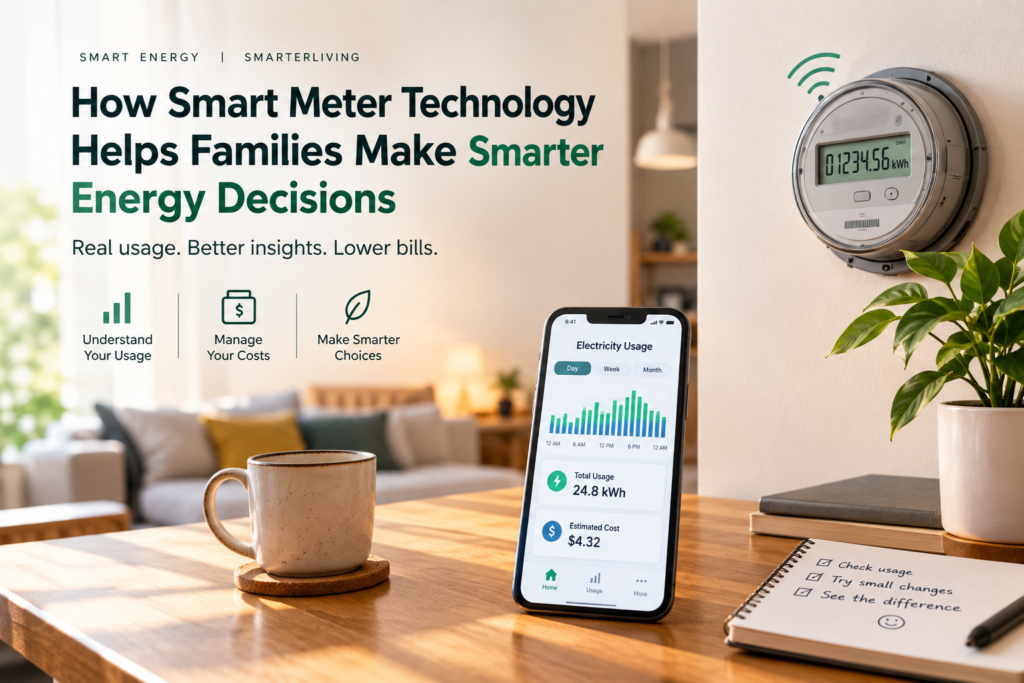
Smart meter technology gives families a clearer picture of how they use electricity, when their consumption rises, and where changes may help control household costs. Instead of relying only on a monthly bill, households with access to detailed meter data can review usage patterns and make decisions based on what is actually happening at home.
The technology is useful, but its benefits are often misunderstood. A smart meter does not automatically make appliances more efficient, reduce electricity prices, or guarantee lower bills. Its real value is the information it provides and how a household uses that information.
For families managing heating, cooling, laundry, cooking, electronics, and other everyday expenses, that information can make energy decisions more practical. The key is to understand the data, identify changes worth testing, and measure whether those changes make a difference.
What Is Smart Meter Technology?
A smart meter is a digital utility meter that measures electricity consumption and can communicate readings to the utility. Depending on the system, it may provide detailed usage information to the household through an online account, mobile app, in-home display, or downloadable data.
Traditional meters generally show cumulative consumption, which makes it harder to see exactly when electricity use increases. Smart metering systems can record usage at shorter intervals and transmit information automatically. The available detail and update frequency vary by meter, utility, and service.
The U.S. Energy Information Administration’s smart meter overview explains that advanced metering infrastructure includes systems that record electricity use at least hourly and provide data to utilities and customers at least daily. Some systems offer more frequent information.
This distinction matters because not every smart meter gives a family an immediate, appliance-by-appliance view of its electricity use. Before making decisions, households should check which features their utility actually provides.
5 Ways Smart Meters Help Families Make Better Energy Decisions
1. Understand when household electricity use increases
A monthly bill tells a family how much electricity it used over a billing period. More detailed meter data can help explain when that consumption occurred.
For example, a household might notice that electricity use rises during the late afternoon. That pattern could reflect air conditioning, cooking, laundry, electric water heating, or several activities happening together. The meter data identifies the timing of higher consumption, although it may not identify the exact appliance responsible.
Families can compare weekdays with weekends and examine periods when the household is occupied or mostly empty. These comparisons help turn a general concern about high bills into a more specific question: what is using electricity, and when does it happen?
The goal is not to eliminate normal household activity. It is to understand which patterns are necessary and which might be changed without making the home less comfortable.
2. Find opportunities to reduce avoidable energy use
Electricity consumption can increase because of heating and cooling settings, equipment left running, inefficient appliances, or habits that are easy to overlook. Smart meter data can help households notice unusual or repeated increases.
Suppose a family’s usage is consistently higher on evenings when several appliances run at once. The family could check whether laundry, dishwashing, and other flexible tasks can be spread out. If consumption rises even when the household is away, it may be worth investigating heating, cooling, water heating, refrigeration, or other equipment that continues operating.
These are starting points for investigation, not proof that a particular appliance is wasting energy. A smart meter usually measures the home’s overall electricity use. Identifying the cause may require checking appliance settings, reviewing equipment information, or measuring an individual device with a suitable energy monitor.
This approach is more useful than making several changes at once. Test one practical adjustment, review the data, and keep it if the results justify the effort.
3. Make electricity bills easier to understand
Smart meters can send readings automatically, reducing the need for manual meter readings and helping utilities bill from recorded consumption rather than estimates. The exact billing process still depends on the utility and the account.
More detailed usage information can also help families investigate a bill that looks unusually high. They can compare consumption during the current period with previous periods and look for changes in usage.
However, a higher bill does not always mean the household used substantially more electricity. The amount charged can also change because of electricity rates, fixed charges, taxes, billing-period length, or other adjustments.
A useful review therefore separates two questions:
- Did electricity consumption increase? Compare the kilowatt-hours (kWh) used over comparable periods.
- Did the cost per unit or other charges change? Review the rate plan and itemized bill.
This distinction prevents families from blaming their habits for a price increase or assuming that lower consumption must always produce a proportionate reduction in the total bill.
4. Decide whether changing the time of appliance use is worthwhile
Some utilities offer time-of-use rates, under which electricity prices vary by time of day. Where these plans are available, shifting flexible activities to cheaper periods may reduce costs without reducing the amount of work a household needs to do.
For example, a family might be able to run a dishwasher or charge an electric vehicle during a lower-priced period. Smart meter data can help the family understand when electricity is being used, while the utility’s rate schedule explains when that usage costs more or less.
The important condition is that the household must actually have a rate plan that rewards the change. Under a flat-rate plan, moving the same electricity use from evening to midday may not reduce the bill.
Before changing routines, check:
- Whether the utility offers a time-of-use or other time-varying rate.
- The exact hours and prices for each period.
- Whether the plan has additional fees or conditions.
- Whether the household can shift enough usage to make the change worthwhile.
Do not assume that off-peak hours are the same across utilities. Check the current tariff, and compare the potential savings with any inconvenience or extra cost.
5. Check whether energy-saving changes are working
Families often make energy improvements without measuring the results. They may adjust a thermostat, replace lighting, change laundry habits, or improve equipment settings, but a later bill alone may not show whether the change helped.
Smart meter data gives households another way to evaluate those decisions. A family can record its normal consumption, make one change, and compare usage afterward.
The evidence supports a measured approach rather than a guaranteed-savings claim. An OECD review of research into household energy feedback reported that an Ontario study found an average reduction of about 3% in electricity demand after households received in-home displays. The report also describes mixed results across studies and notes that outcomes depend on context and the type of feedback provided. This finding is evidence that feedback can influence behavior, not a promise that every household will save 3%.
Families should use their own consumption records to assess results, while allowing for weather, occupancy, seasonal demand, and other changes that can affect comparisons.
A Practical Example: Turning Meter Data Into a Decision
Consider a hypothetical family that notices its electricity use is regularly higher between 5 p.m. and 9 p.m. The meter data shows the pattern, but it does not establish the cause.
Instead of immediately buying new appliances, the family could follow a simple process.
Step 1: Establish a baseline. Review several comparable days and note the household’s electricity use during the evening period.
Step 2: Investigate the pattern. Check whether air conditioning, electric cooking, laundry, water heating, or other activities explain the increase. Consider weather and the number of people at home.
Step 3: Choose one change. If the rate plan rewards off-peak use, move a flexible activity to a lower-priced period. If the household has a flat rate, test a change that reduces total electricity consumption instead.
Step 4: Compare like with like. Review similar weekdays or weekends and account for major differences in weather and occupancy. Compare kWh as well as the bill amount.
Step 5: Decide based on the result. Keep the change if it produces a meaningful benefit without creating unnecessary inconvenience. If the data does not show a clear improvement, reassess the cause rather than assuming the meter has failed.
This example is illustrative, not a report of a measured household result. Its value is the method: observe, test, compare, and make the next decision using evidence.
How to Read Smart Meter Data Correctly
Detailed readings are only helpful when families interpret them carefully. A few basic practices can prevent misleading conclusions.
Compare similar periods. Electricity use in a hot summer week may be very different from use during mild weather. Compare periods with reasonably similar conditions wherever possible.
Look at kWh and cost separately. Kilowatt-hours measure electricity consumed. The bill reflects consumption plus applicable rates and other charges. A change in one does not necessarily mean the same proportional change in the other.
Check the reporting interval. Some utility portals update more frequently than others. Delayed data can make it difficult to connect a reading to a particular activity immediately.
Avoid drawing conclusions from a single spike. A brief increase could reflect normal cooking, heating, cooling, or another temporary activity. Look for repeated patterns before deciding that something needs attention.
Confirm unusual readings. If usage appears inconsistent with household activity, review the billing period, meter readings, utility explanations, and any available troubleshooting guidance. Contact the utility if the discrepancy remains unexplained.
These steps help families use the meter as a decision-making tool rather than treating every graph or alert as a definitive diagnosis.
Smart Meter Privacy: What Families Should Check
Smart meters can generate more detailed records of household electricity use than older meters. That information can help with energy management, but it deserves careful handling.
The data available to a utility, household account holder, or third-party service depends on the metering system, applicable rules, and permissions. Families should not assume that every provider collects the same information or follows identical access procedures.
Before connecting energy data to an app or other service, check:
- What information the service requests and how frequently it receives updates.
- Whether the information is stored or shared with other organizations.
- What permission is required to share data with a third party.
- How access can be withdrawn and an account or connection closed.
- What security and privacy information the utility and service provider publish.
The U.S. Department of Energy’s Green Button initiative describes ways customers can access and download their energy-use data, including options for sharing it with third-party services when supported by the utility. The available features vary, so households should verify what their provider offers and review the terms of any service they choose.
A useful energy app should make data easier to understand without requiring families to share more information than necessary.
What Smart Meters Cannot Do
Understanding the limits of smart meter technology is just as important as understanding its benefits.
A smart meter does not automatically reduce consumption. Lower use generally requires a household to change an activity, improve equipment efficiency, or make another effective adjustment.
It does not always identify individual appliances. Whole-home readings may show when demand rises, but separate monitoring may be needed to identify the source.
It does not guarantee a lower bill. Electricity rates, fixed charges, weather, household size, and usage patterns all influence the final amount.
It does not make every time-shifting strategy financially worthwhile. The result depends on the household’s tariff and the amount of consumption that can realistically be moved.
Finally, smart meter features are not identical everywhere. Access to an in-home display, detailed intervals, alerts, downloadable records, or time-based rates depends on the utility and local arrangements.
Families will make better decisions when they understand these limitations before spending money or changing their routines.
Frequently Asked Questions
Do smart meters help families save money?
They can help families identify usage patterns, monitor consumption, and make better-informed choices. Savings are not automatic and depend on whether the household makes effective changes, its electricity rates, and its circumstances.
Can a smart meter show which appliance uses the most electricity?
Usually, a standard whole-home smart meter measures the property’s total electricity use rather than naming individual appliances. Detailed monitoring tools may help identify specific devices, but this capability should not be assumed.
Do smart meters lower electricity bills automatically?
No. Automatic readings can reduce reliance on manual readings and estimated billing, but the meter itself does not guarantee lower consumption or cheaper rates.
Is it worth using a smart meter app?
It can be useful if the app provides understandable data that helps the household make decisions. Check the update frequency, available features, privacy terms, and whether the information is detailed enough for the task.
Should families change when they run appliances?
Only when the change makes sense for their circumstances. Under a time-of-use plan, shifting flexible activities to cheaper periods may reduce costs. Under a flat-rate plan, the household may need to reduce total consumption instead.
Are smart meters safe for household data?
The answer depends on the system’s security measures, data-access rules, and how information is shared. Families should review their utility’s privacy information and carefully consider any third-party app permissions.
Final Thoughts
Smart meter technology helps families make smarter energy decisions by turning electricity use into information they can review and act on. It can reveal recurring patterns, support better bill checks, and help households assess whether changes to their routines are effective.
The most useful approach is straightforward: learn what the meter and utility account can show, establish a baseline, test one realistic change, and compare similar periods before deciding whether it worked.
The goal is not to watch every reading or change every household habit. It is to use reliable information to make a few better decisions, protect privacy, and understand what actually influences the family’s energy costs.