
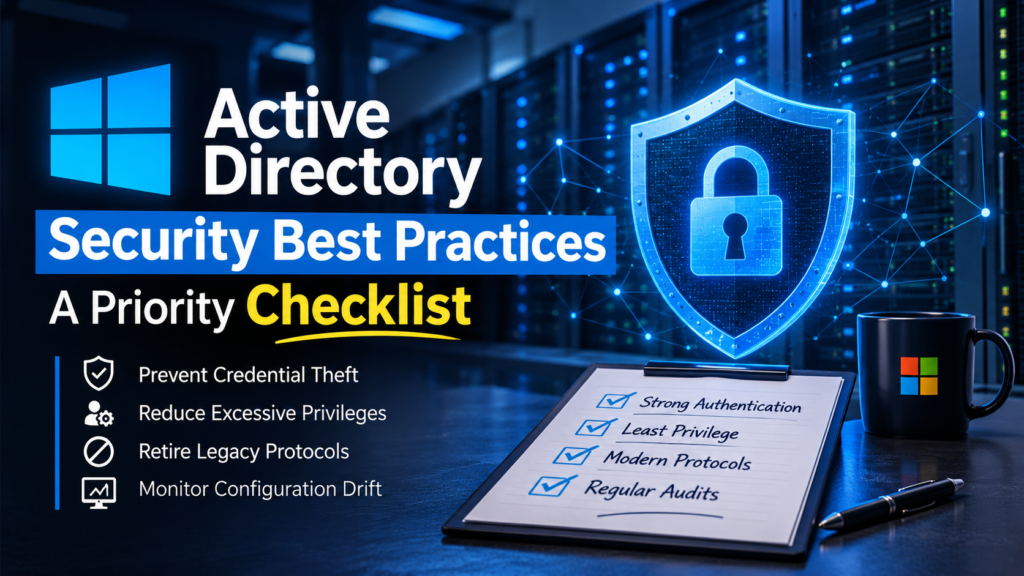
Active Directory sits at the center of nearly every enterprise network, controlling who can log in, what they can access, and how systems trust one another. That centrality makes it one of the most attractive targets for attackers, and one of the most damaging systems to lose control of. A compromised domain controller does not just expose one application. It can hand an attacker the keys to the entire environment. Hardening Active Directory effectively requires prioritization, because trying to fix everything at once usually means fixing nothing well. The following checklist orders the most consequential risks first: credential theft, excessive privilege, legacy protocols, and configuration drift.
Why Active Directory Attracts Attackers First
Attackers who breach a network rarely stop at the first system they access. Their goal is usually to move laterally until they reach an account or system with broad control, and Active Directory is often the fastest path there. A single set of compromised domain administrator credentials can grant access to file servers, email systems, and clinical or financial applications alike, all through the trust relationships Active Directory manages by design.
This is why security assessments consistently identify identity infrastructure as a disproportionately high-value target relative to its visibility in day-to-day operations. Many organizations invest heavily in endpoint protection and network monitoring while treating Active Directory hardening as a lower priority, even though it often represents the shortest route to full domain compromise once an attacker gains an initial foothold.
Stopping Credential Theft Before It Spreads
Credential theft techniques such as pass-the-hash, Kerberoasting, and DCSync attacks remain among the most common methods attackers use to escalate access within a domain. These techniques exploit weaknesses in how credentials are stored, cached, and validated, often without triggering obvious alerts. Addressing this risk is typically the highest-priority item in any set of active directory security best practices, because credential compromise is usually the mechanism that turns a minor breach into a full domain takeover.
Practical steps that reduce credential theft risk include enforcing strong password policies alongside multi-factor authentication for privileged accounts, limiting where administrative credentials can be used through tiered administration models, and monitoring for the specific behavioral patterns associated with common credential attacks. Restricting the caching of privileged credentials on lower-tier systems also closes off a common lateral movement path that attackers rely on once they compromise a single workstation.
Reducing Excessive Privilege Across Accounts
Privilege creep tends to accumulate quietly over time. Accounts gain administrative rights for a temporary project and keep them indefinitely, service accounts inherit broader permissions than they need, and departing employees’ access is not always fully cleaned up. Each unnecessary privilege represents an opportunity an attacker could exploit, whether directly or by compromising an account that itself has excessive rights.
A structured review process addresses this systematically. The following priorities tend to deliver the most risk reduction relative to effort:
- Auditing membership of privileged groups such as Domain Admins and Enterprise Admins, removing accounts that do not require standing access
- Implementing just-in-time or time-limited privileged access rather than permanent administrative rights
- Reviewing service account permissions separately, since these accounts are frequently over-provisioned and rarely monitored as closely as human accounts
- Establishing a regular cadence, such as quarterly, for re-certifying who genuinely needs elevated access
This kind of privilege reduction is one of the more resource-intensive elements of active directory security best practices to implement, largely because it requires coordination across departments rather than a single technical fix. However, it consistently ranks among the highest-impact changes an organization can make, since limiting standing privilege directly limits what an attacker can do even after gaining initial access.
Retiring Legacy Protocols That Undermine Modern Defenses
Many Active Directory environments still support older protocols such as NTLM and unsigned LDAP for the sake of compatibility with aging applications. These protocols were not designed with today’s threat landscape in mind and lack protections that modern authentication methods provide by default. Attackers specifically look for environments where these legacy protocols remain enabled, because they offer a more reliable path to credential interception or relay attacks than newer alternatives.
According to guidance detailed by Semperis on Active Directory security best practices, disabling or restricting legacy protocol usage is one of the more straightforward hardening steps available, though it requires careful testing to avoid breaking dependent applications. A phased approach generally works best: identifying which systems still rely on legacy protocols, migrating or upgrading those systems where feasible, and enforcing modern protocol requirements domain-wide once dependencies are resolved.
Catching Configuration Drift Before It Becomes a Vulnerability
Even a well-hardened Active Directory environment degrades over time without ongoing attention. Group policy settings get modified for one-off troubleshooting and never revert. New administrators make changes without full context on prior security decisions. Trust relationships get added for a specific project and remain long after that project ends. This gradual divergence from an organization’s intended security baseline is known as configuration drift, and it is difficult to catch without deliberate monitoring.
Addressing drift requires establishing a documented security baseline in the first place, then auditing the environment against it on a regular schedule rather than only after an incident raises concern. Automated tools that flag unauthorized changes to sensitive objects, such as Group Policy Objects or domain trust configurations, help catch drift before it accumulates into a meaningful gap. Change management processes that require review before modifications to sensitive Active Directory objects also reduce the likelihood of unintentional drift in the first place.
Key Takeaways
Hardening Active Directory works best as a prioritized effort rather than a checklist tackled in whatever order feels convenient. Credential theft protections address the mechanism attackers rely on most to escalate access. Privilege reduction limits the damage even a successful compromise can cause. Retiring legacy protocols removes some of the easiest paths attackers exploit for interception and relay. Ongoing monitoring for configuration drift keeps the environment aligned with its intended security posture over time, rather than allowing gradual erosion to go unnoticed.
None of these steps function as a one-time project. Active Directory security requires continuous attention because both the environment and the threats targeting it keep changing, and a hardening effort completed once and never revisited tends to lose its effectiveness within a year or two.