
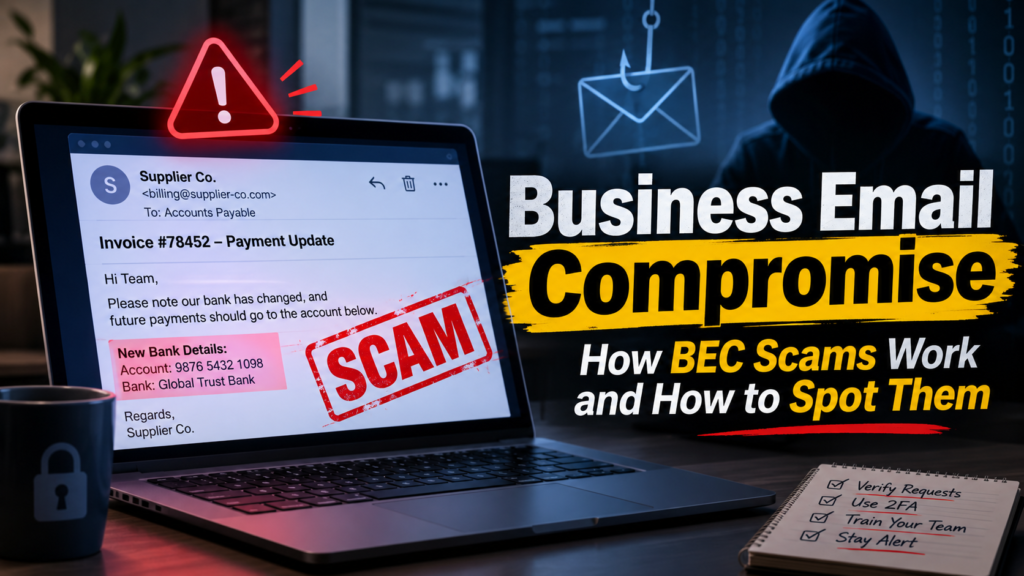
A message arrives in the accounts payable inbox from a supplier the company has paid for years. The tone is polite and the invoice looks identical to the last one. Only a single line differs: “Please note our bank has changed, and future payments should go to the account below.” Nobody questions it, the payment goes out, and weeks later the real supplier asks why they have not been paid.
That story, in countless variations, is a business email compromise. It involves no malware, no exploit, and often no technical sophistication at all. The scam succeeds because it borrows trust that already exists. For finance teams, executives, and IT staff, understanding the pattern is the best protection, because the pattern is surprisingly consistent. The sections below describe how it unfolds, what real cases look like, which signs give it away, and which controls stop it.
Why This Scam Costs So Much
Business email compromise is a fraud category in which a criminal uses email to impersonate a trusted person or organization and persuade someone to send money or sensitive information. The FBI’s Internet Crime Complaint Center has consistently ranked it among the costliest categories of cybercrime in its annual reports, with losses far above those of many attacks that attract more headlines.
Part of the reason is the size of each loss. A single successful fraud can involve an entire invoice, a payroll run, or a property purchase, and the funds are often moved through several accounts within hours. Victims are also reluctant to report quickly, either from embarrassment or because the fraud is not discovered until the real supplier or executive notices the problem.
Another reason is how little the criminals need. Many versions are text only, with no links or attachments that security tools usually flag. A message that asks a question or makes a request in plain language can pass every filter. The attacker’s real tools are research, patience, and an understanding of how a particular business pays its bills.
Because the scam targets process rather than software, it appears in every industry and every company size. Small firms are not overlooked, and in many cases they have fewer verification steps than large ones.
The Typical Flow of BEC Attacks
Most BEC attacks follow a recognizable sequence. First comes preparation. The criminal studies the target through its website, press releases, and professional networking profiles, identifying who approves payments, who the executives are, and which suppliers are used. Sometimes the attacker goes further and breaks into a real mailbox, then reads actual threads to copy their style.
Next comes impersonation. The attacker either spoofs an address, registers a lookalike domain with a small change such as a swapped letter, or sends from a genuinely compromised account. The last option is the hardest to detect, since the message comes from the real address and sits in an existing conversation.
Then comes the request, wrapped in urgency. Typical asks include a payment to a “new” bank account, an urgent wire for a confidential deal, a change to payroll direct deposit details, or a purchase of gift cards for clients. The message may stress that the executive is traveling, unable to take calls, and needs the matter handled quietly. Secrecy and time pressure keep the recipient from checking.
Finally, the money moves, and the criminal works to move it again quickly. If the victim notices within a day or two, the bank may be able to recall a transfer. After that, recovery becomes unlikely. These BEC attacks reward speed on the criminal’s side and delay on the victim’s.
What Real Cases Look Like
Several patterns appear again and again. In the vendor invoice scheme, a supplier’s email account is taken over, and the attacker sends a legitimate invoice with altered banking details. The customer pays the new account, and both companies discover the problem later. Because the supplier is a real partner, the fraud can run for months before anyone notices.
In the executive impersonation scheme, a message appears to come from the chief executive or chief financial officer and asks a junior finance employee for an urgent transfer. The address may differ by one character, or the display name alone may be forged. The target is often a new hire, who is eager to help and less likely to question a senior person.
A third pattern involves payroll. A message that appears to come from an employee asks HR to update direct deposit details, and the next salary payment goes to the criminal. Real estate transactions have also been targeted, with fraudulent emails sending buyers incorrect wiring instructions shortly before closing.
A fourth variation uses attorney impersonation, where a supposed lawyer says a confidential matter requires an immediate payment. In every case, the structure is the same: a trusted identity, a plausible context, a departure from usual process, and a short deadline. Spotting the structure is easier than spotting any single forged detail.
Red Flags Worth Training Everyone to Notice
No single clue is decisive, but several together should stop a payment. Finance staff, executives, and IT teams can all learn to look for the following:
- A request to change bank details, especially by email alone
- Urgency or pressure to act before checking
- Requests for secrecy or to avoid normal approval steps
- A sender address that differs slightly from the usual one
- A reply-to address that does not match the sender
- A change in writing style, greeting, or signature
- An executive “unavailable by phone” who needs money moved
- Requests for gift cards, cryptocurrency, or payment to a personal account
- Payment instructions that arrive immediately before a deadline
IT teams can add technical clues. Message headers may show a mismatch between the visible sender and the actual return path, or a domain registered only days earlier. Mailbox audit logs may reveal new forwarding rules or logins from unfamiliar locations in the days before a suspicious request.
Context counts as well. If a request does not match how the organization normally does business, that mismatch is itself a warning. A supplier that has always invoiced through a portal suddenly asking for payment by wire, for example, deserves a call. Encourage staff to trust that feeling and verify, since a minute of checking costs far less than a recovered transfer.
Prevention Controls That Work
The most effective control is procedural. Require verification by a second channel for any change to payment details or any unusual transfer, using a phone number already on file and never one supplied in the request. Pair this with dual approval for payments above a set threshold, so one person cannot send a large sum alone. These rules work even when the email is flawless.
Technical controls add depth. Email authentication through SPF, DKIM, and DMARC makes it harder to forge the company’s own domain. Filters that flag lookalike domains, external senders using executive names, and first-time contacts requesting payment changes catch many attempts. Multi-factor authentication, preferably phishing-resistant, protects mailboxes from takeover, and alerts on new forwarding rules reveal quiet intrusions.
People remain part of the defense. Training should use realistic examples from finance and executive support roles and should include practice in verifying a request. Executives should agree not to send urgent payment requests by email alone, so staff know that any such message is suspect.
Preparation for failure matters too. Finance should know the bank’s fraud contacts and how to request a recall, and the incident plan should say who calls whom in the first hour. Speed after discovery is often the difference between recovering funds and writing them off.
End Note
Business email compromise works because it fits inside normal business routines. The impersonation, the urgency, and the changed payment details are all designed to look like ordinary work performed slightly faster than usual.
Finance teams, executives, and IT staff each hold part of the defense: verification habits, visible leadership rules, and technical controls on mail and identity. When those pieces line up, the scam loses its main advantage, which is the assumption that nobody will stop to check.
Smaller finance teams can start with two rules: no payment detail changes without a callback, and no large transfers without a second approver. Written down and applied every time, those rules turn a vague worry about fraud into a procedure that staff can follow without hesitation.